
Balsamic Vinegar of Modena: Complete Guide | Mangiare a Modena
Balsamic Vinegar of Modena: IGP vs Traditional DOP differences, production, vinegar cellars (acetaie), and culinary uses. Complete local guide.
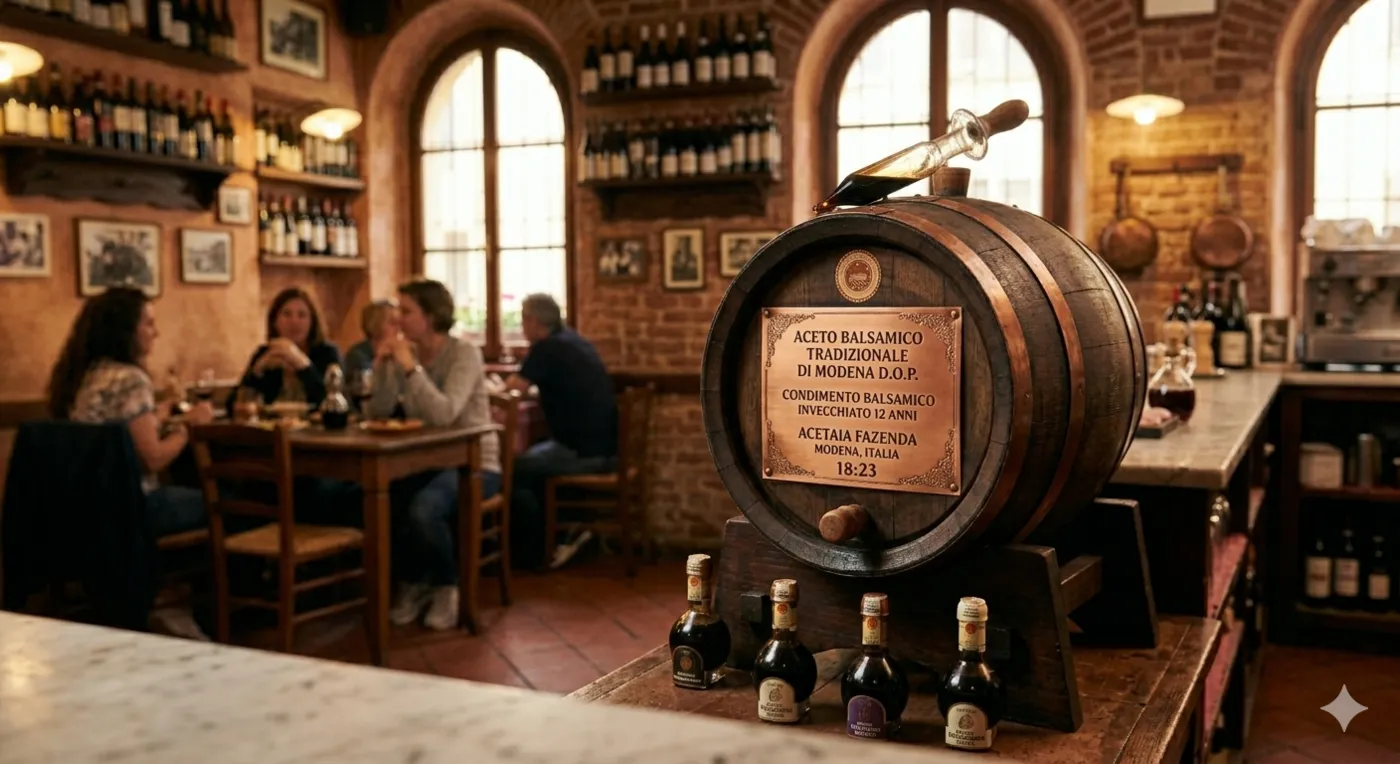
There is a product that carries the name of Modena around the world more than any other — more than Ferrari, more than Bottura, more than tortellini. It is Traditional Balsamic Vinegar of Modena, a condiment produced in attics, aged for decades in small wooden barrels, and sold in a 100ml bottle designed by one of Italy's greatest designers.
The problem is that almost no one knows what it really is. What you buy at the supermarket labeled "balsamic" has almost nothing in common with the original product. This guide exists to explain the difference — and to help you take home the right product if you are in Modena.
What is Balsamic Vinegar of Modena
The name "Balsamic Vinegar of Modena" actually covers two completely different products, protected by two distinct European trademarks.
Traditional Balsamic Vinegar of Modena DOP
This is the original product. It is produced exclusively from the cooked must of grape varieties native to the province of Modena — mainly Trebbiano and Lambrusco. The must is cooked slowly until it reduces by about 30-50%, then sent to a long aging process in a series of barrels called a battery.
A battery consists of 5 to 7 barrels made of different woods — oak, chestnut, cherry, mulberry, ash, juniper — of decreasing sizes. Every year, a portion of the product from the smallest barrel is taken for bottling, and each barrel is topped up from the next largest one. The process requires a minimum of 12 years for the base version and 25 years for the Extravecchio.
The result is a dense, dark liquid with a complex aroma reminiscent of wood, dried fruit, caramel, and vinegar — but with a sweetness and depth that no other vinegar in the world possesses.
It is bottled exclusively in the 100ml bottle designed by Giorgetto Giugiaro in 1987 — a flattened sphere shape with a screw cap — featuring different colored labels depending on the aging: bordeaux for the minimum (12 years) and gold for the Extravecchio (25 years).
Balsamic Vinegar of Modena PGI (IGP)
This is the product found commercially in large supermarkets. The PGI regulations are much less strict: they allow the use of wine vinegar in variable percentages, the addition of concentrated grape must, and in some cases caramel as a coloring. Production times are enormously reduced compared to the Traditional version.
It is not a fake or poor-quality product by definition — there are good-quality PGI vinegars, produced with care and aged for a few years. But it is an industrial product in its most economical version, and should not be confused with the Traditional one.
The price difference reflects the product difference: a Traditional DOP costs €40–€100 for 100ml, while a basic PGI costs just a few euros for a 250ml bottle.
The History of Traditional Balsamic Vinegar
Modenese balsamic vinegar has ancient origins — the first documented references date back to the 11th century, when Bonifacio of Canossa gave Henry III of Franconia a barrel of precious vinegar produced on his lands.
For centuries, it was an exclusive product of Modenese aristocratic families, produced in the attics of country villas and passed down from generation to generation as a family heirloom. The "batteries" were inherited, given as dowries, and gifted among nobles. It was not a condiment — it was almost a medicine, an elixir.
The word "balsamic" first appears in 18th-century documents, indicating the beneficial and aromatic properties of the product. It has remained to this day, even though it has lost its original meaning due to the indiscriminate use of the term in food marketing.
Recognition as a Protected Designation of Origin (PDO/DOP) arrived in 2000, and in 2009 it obtained European DOP status. The regulations protect both the production method and the exclusive geographical origin within the province of Modena.
How It Is Produced: The Stages
Understanding how Traditional Balsamic Vinegar is made helps explain why it costs what it costs.
Harvest and Must Cooking (Autumn) The grapes — predominantly Trebbiano di Spagna and Lambrusco — are harvested late to maximize sugar concentration. The freshly pressed must is boiled in open vats over direct heat until it reaches a concentration of about 30 Brix degrees. During cooking, the volume reduces by 30-50%.
Fermentation and Starting The cooked must is left to ferment spontaneously in large containers, then transferred to the largest battery barrel. Here, the slow transformation into vinegar begins through bacterial oxidation.
Annual Racking Once a year, usually in winter, the producer takes a small quantity from the smallest barrel — the one that will eventually be bottled — and tops up each barrel from the next largest one. This process distributes and transfers bacterial colonies and wood aromas.
Aging The product remains in the battery for at least 12 years before it can be certified. During this period, it evaporates slowly through the wooden staves — the "tears of the barrel" — concentrating further. A barrel starting with 10 liters ends up with 2-3 liters after 25 years.
Tasting and Certification Before bottling, each batch is tasted by a panel of Consortium experts who evaluate its color, density, aroma, and taste. Only approved batches can be bottled in the DOP bottle.
Where to Visit Vinegar Cellars (Acetaie) in Modena
Visiting an acetaia is one of the most special experiences you can have in the province of Modena. The barrels are located in the attics of houses and country villas — dusty environments, hot in summer, cool in winter, with rows of dark barrels emitting an unmistakable scent of wood, vinegar, and fruit.
Consorteria dell'Aceto Balsamico Tradizionale — Spilamberto
The Consorteria is the historic association of Traditional Balsamic Vinegar producers, founded in Spilamberto in 1967. It organizes guided tours of the Traditional Balsamic Museum and tastings. It is the best place to systematically understand the history and production process.
How to get there: Spilamberto is about a 20-minute drive from Modena, towards Vignola.
Acetaia Pedroni — Nonantola
One of the historic vinegar cellars of the province, active for multiple generations. It accepts visits by reservation with guided tastings. Their Traditional Extravecchio is considered among the best of the denomination.
Acetaia Sereni — Castelfranco Emilia
One of the internationally best-known vinegar cellars, featuring a wide range of products and a well-organized shop. Guided tours are structured and accessible even to those approaching the product for the first time.
Acetaia Valeri
Small family production, visits by appointment. The experience is more intimate than commercial acetaies — you are welcomed by the family, taste directly from the barrels, and buy straight from the producer.
How to organize a visit: The Modena Tourist Office in Piazza Grande (open daily) has an updated list of visitable vinegar cellars with contacts and schedules. Some require booking weeks in advance, especially in spring and autumn.
How to Use Traditional Balsamic Vinegar in Cooking
Traditional DOP is used very sparingly and raw. It is not cooked, not heated, and not used as a salad dressing — that would be an unjustified waste.
Classic pairings in the Modenese tradition:
Aged Parmigiano Reggiano The classic par excellence. A few drops of Traditional on a piece of Parmigiano aged 36 months or more — the sweetness of the vinegar contrasts the saltiness of the cheese in an extraordinary way.
Fresh Strawberries A pairing that always surprises those who do not know it. Half-cut strawberries with two drops of Traditional and a pinch of cane sugar make a simple and memorable dessert.
Crema or Vanilla Gelato Three drops of Extravecchio on a scoop of cream gelato. One of the best things you can eat in Modena.
Roast or Boiled Meat Modenese mixed boiled meat (bollito misto) with a few drops of Traditional is a historic pairing. It also works wonderfully with rare beef fillet.
Veal Liver A classic pairing of Emilian cuisine. Liver sautéed in a pan with butter and sage, finished with a drop of Traditional at the end of cooking.
Parmesan Risotto A teaspoon of Traditional poured over plated risotto — not during cooking — adds a note of complexity impossible to achieve otherwise.
How to Choose and Where to Buy
What to Look For on the Label
Traditional Balsamic Vinegar of Modena DOP: The original product. Look for the 100ml bottle with the Consortium seal and the bordeaux label (12 years) or gold label (25 years). No other packaging forms are authorized.
Quality PGI (IGP) Balsamic Vinegar of Modena: If you want a product for everyday use — salads, marinades, cooking — look for a PGI with an indication of aging (at least 3 years), medium-high density, and no caramel among the ingredients. The most reliable producers indicate the percentage of concentrated grape must on the label.
What to Avoid: Anything called "balsamic cream", "balsamic glaze", or "balsamic condiment" without a DOP or IGP indication is a very low-cost industrial product. It often contains more thickeners than vinegar.
Where to Buy in Modena
Directly at the Vinegar Cellars: The best way to ensure product authenticity and hear the producer's direct history. Prices are often better than shops in town.
Albinelli Market: Some stalls in the covered market sell quality Traditional DOP and PGI Balsamic Vinegar. Always ask to taste before buying.
Specialty Shops in the Center: Several traditional product shops in Modena's historic center have curated selections of Traditional DOP. Avoid souvenir shops near tourist attractions — the quality-to-price ratio tends to be unfavorable.
Online: Consorzi and historic acetaies sell directly online with shipping throughout Italy and Europe.
PGI vs Traditional DOP: Which One to Buy?
It depends on how you plan to use it.
Buy Traditional DOP if:
- You want to make an important, sophisticated gift
- You have specific pairings in mind (Parmigiano, gelato, strawberries)
- You are in Modena and want to take home the authentic product
- You have a budget of €40 and up for 100ml
Buy a good PGI if:
- You use it regularly in the kitchen to dress salads, marinate meats, finish risottos
- You are looking for a quality everyday product under €20
- You want to get familiar with the product before investing in the Traditional version
Balsamic Vinegar of Modena in the World
PGI Balsamic Vinegar of Modena is one of the most exported Italian products in the world — according to Consortium data, over 90% of PGI production is exported, with primary markets in Germany, the United States, Canada, and Australia.
This has created a paradoxical situation where the product is extremely well known abroad in its industrial version, while Traditional DOP — the original product — is almost unknown outside Italy.
Visitors who come to Modena and discover Traditional for the first time are almost always astonished by the difference. It is not just a matter of quality — it is a matter of category: these are two products that share a name but have almost nothing in common in terms of history, process, and use.
Curiosities and Anecdotes
The Battery as a Family Heirloom: In traditional Modenese families, barrel batteries are inherited and passed down as family treasures. Some active batteries today are over 150 years old. The product they contain is the result of generations of care and patience.
The Palio of San Giovanni: Every year in Spilamberto, the Palio of Traditional Balsamic Vinegar takes place, a competition among producers who challenge each other in the evaluation of their vinegar by a panel of experts. It is one of the province's most heartfelt events.
The Gift of Kings: The tradition of donating balsamic vinegar to sovereigns and dignitaries is documented since the Middle Ages. In 2000, on the occasion of the Jubilee, a historic battery was donated to Pope John Paul II.
The Giugiaro Bottle: The shape of the Traditional DOP bottle was commissioned in the 1980s from designer Giorgetto Giugiaro — the same man who designed the Volkswagen Golf and Fiat Panda. The flattened sphere bottle is now an icon of Italian design recognized worldwide.
Where to Eat in Modena with Traditional Balsamic Vinegar
If you want to taste Traditional DOP in a restaurant setting, quality Modenese trattorias use it regularly as a finishing touch:
Trattoria Aldina and Trattoria Bianca in the historic center often offer it on Parmigiano as an appetizer or as an accompaniment to boiled meat. If you don't see it on the menu, ask — they often have it even if they don't advertise it.
For an experience dedicated entirely to the product, visitable vinegar cellars almost always include a final tasting where Traditional is served on various pairings — Parmigiano, prosciutto, gelato — with an explanation of the differences between aging periods.